

Fine-tuning Mistral for an enhanced content search experience (part IV)
The UX perspective
Legacy article
This post reflects an earlier stage of Empathy Platform development. Some of the tools, integrations, or approaches described here are no longer in use in our current stack.
Since then, our focus has evolved towards self-hosted, private, and sustainable AI infrastructure, where compute is treated as part of the product itself. All AI compute is currently run on Empathy’s own GPU environment, hosted in our net-zero energy, bioclimatic private cloud in Asturias.
Rather than updating this article to fit our current approach, we’ve chosen to preserve it as a record of our R&D history and innovation journey.
For our current approach and latest developments, explore our main blog section.
In our series on fine-tuning Mistral for an enhanced content portal search experience, we have covered the general overview, the backend, and the infrastructure perspectives. In this final part, we focus on the user experience (UX) perspective, detailing how we created an intuitive and user-friendly search experience.
Bridging technical excellence and user experience
The main goal of our frontend and UX efforts was to ensure that the powerful capabilities developed in the backend, supported by a robust infrastructure, translated into a seamless and engaging user experience. Our strategy centered around elevating the search experience by making the AI-driven search both familiar and innovative for users.
Incorporating AI into the search layer
We recognized that our innovative keyword search functionality through contextual holon-based discovery could be overwhelming for new users of the EPDocs portal, especially if they were expecting direct document results.
We love this explorative approach, so we kept it but leveraged the new AI-powered search capabilities to provide a well-rounded search experience. People can now ask questions in natural language and receive precise answers, making the search process more intuitive while preserving contextual understanding. We created a search experience that felt advanced and familiar.
By combining both AI and holon-based keyword search, we now deliver a holistic search experience that balances explorative and immediate response needs. Giving direct and immediate responses addresses people who need quick answers, with AI promptly providing concise and relevant information. However, the explorative search* side allows people to dig into topics through a contextual discovery approach, finding related content organically. So, AI-powered search capabilities act as the starting point for an initial understanding, followed by a deeper exploration through the contextual holon-based experience.
Enhancing familiarity and trust
Ensuring the search interaction felt natural and familiar was a priority. As people became more accustomed to AI tools in their daily lives, making the transition smooth was essential. The AI understands and responds to natural language queries, enhancing the overall user experience.
For example, if you type “What is Empathy Platform?” the AI recognizes the natural language and gives you a direct answer without jumping away to any page to get the response. This gives a concise summary, providing good context to start with. Additionally, the holon-based search pane displays multiple options, allowing further research and discovery of related topics through contextual holons and final page results.
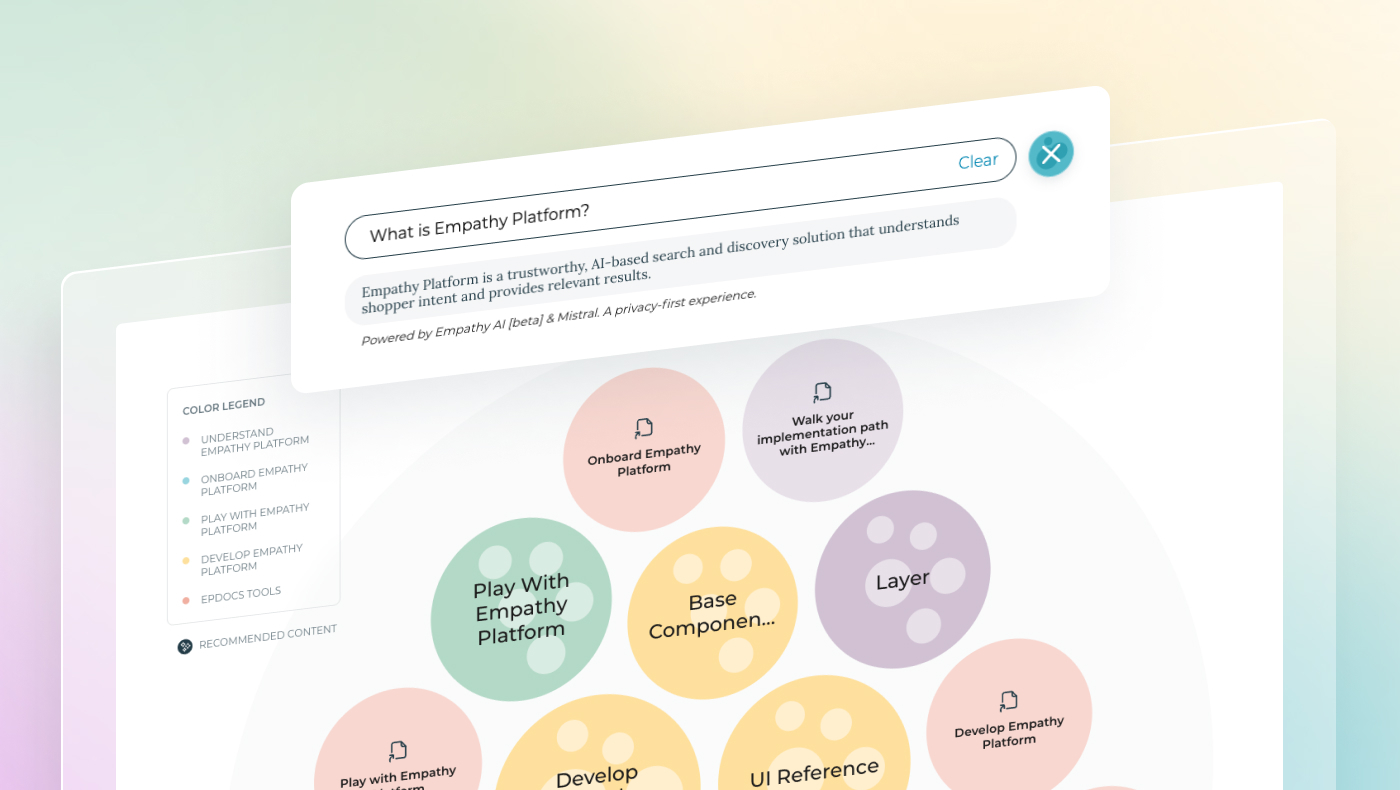
Together, these features significantly enhance the search layer’s potential, redefining our trustworthy search experiences. You know that trust and privacy are paramount at Empathy.co. So, we develop privacy-by-design experiences and measures to ensure people's data and interactions remain private. The AI operates within the Empathy Platform Docs private environment, emphasizing transparency about data usage and privacy protection. Still, we’re working on UX features to enhance relatability and maintain user trust, despite potential AI inaccuracies, for desktop and mobile platforms.
Wrapping up the UX journey
The UX perspective was crucial in translating the technical advancements of our backend and infrastructure teams into a user-friendly and engaging search experience. By integrating natural language processing, maintaining traditional search functionalities, and prioritizing user privacy, we have created a search tool that is both powerful and intuitive.
This concludes our series on fine-tuning Mistral for an enhanced developer’s portal search experience. However, our work doesn’t stop here, as we're continuously evolving in the way we build our products.
Building search, differently
What started as early experimentation has evolved into a more integrated way of building AI search. Today, our work is centered around Empathy.AI, the space where we design and develop AI search systems grounded in self-hosted, private, and sustainable infrastructure.
By treating compute as part of the product itself, we gain greater control, efficiency, and long-term scalability.
Want to explore how this approach shapes what we build today? Discover more about Empathy.AI (opens new window) or dive into our latest articles.