

AI Carousels
No results? Impossible! There's always something relevant to discover
Zero results are one of the biggest drop-off points in any search journey. When shoppers can't find what they're looking for, most of them leave your commerce store and move on to another one. AI Carousels turn these dead-ends into product discovery opportunities. Instead of a blank results page, Empathy Platform displays horizontally scrollable carousels with relevant product suggestions from your catalog, surfaced by AI.
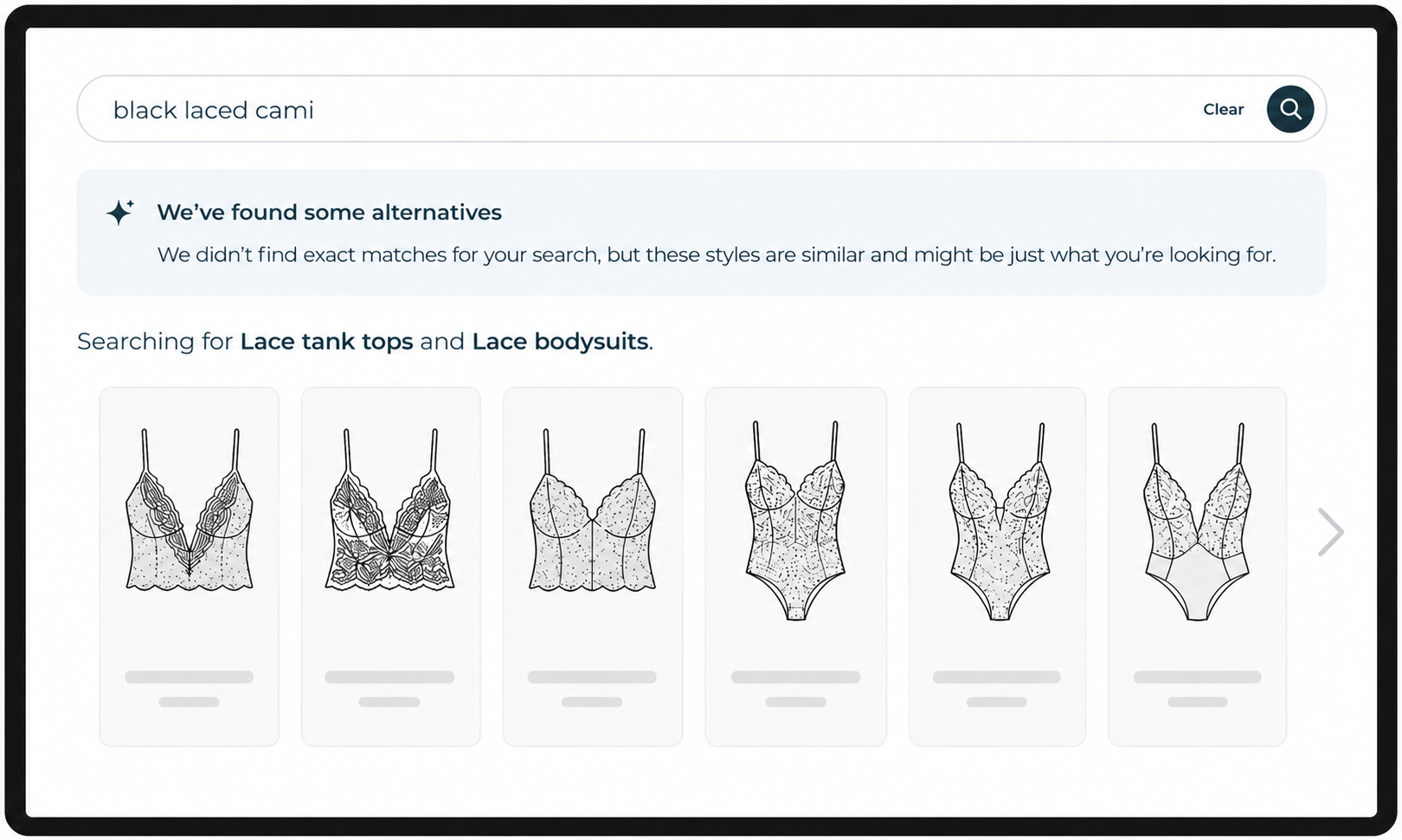
AI Carousels are a fallback mechanism for zero-results. When a search returns no matching products in your catalog, Empathy Platform activates horizontally scrollable carousels with relevant products that match your shopper's search intent. For example, a shopper searching for "black laced cami" on a fashion commerce store may not get matched results at all. But AI Carousels surface lace tank tops, lace bodysuits, lingerie spaghetti-strap tops, and similar styles that match the intent, even when the phrasing doesn't appear in any product listing.
note
AI Carousels require no configuration. The carousel activates automatically when a search returns zero results.
AI Carousels in the search experience
When shoppers hit a wall, they don't try again and leave your store. AI Carousels step in at that moment, replacing a frustrating dead-end with a curated set of semantically relevant products.
Each carousel displays a contextual label that describes the semantic relationship to the original search query. So, for the previous example, the query "black laced cami" that returns no results, Empathy Platform can surface two labeled carousels such as black lace straps and black lace tank top, grouping products by semantic intent rather than keyword overlap and expanding the results list.
This way, shoppers always have relevant products to explore, as the product catalog never leads to dead-ends, and merchants see how bounce rates on zero-results pages drop because their shoppers stay engaged with the catalog.
design tip
For zero-result searches, all related query suggestions and their product results are grouped into a single labeled carousel.
You can configure the number of related queries to generate through the AI Mode tab in the Instance Management Console (IMC) in the Playboard.
Recovering zero-result searches in home and living retail
See how AI Carousels expand product discovery when keyword search falls short
Spot the difference
Unlike Spell Check, which corrects typos, or Partial Results, which recombines query tokens to find keyword matches, AI Carousels don't rely on the shopper's exact wording at all. They generate semantically related queries at query time using large language models, covering zero-result cases without depending on prior traffic or manual configuration.
Despite Semantics Recommendations also surfacing product carousels based on semantic similarity, they only activate on zero-results scenarios, drawing from a predefined set of queries built from organic traffic at index time. AI Carousels generate related query suggestions on the fly, making them effective even for new stores or long-tail queries with little traffic history. This makes AI Carousels the deepest and most reliable fallback in the zero-result stack.
Related Prompts share the same underlying AI infrastructure as AI Carousels but serve as a fallback mechanism in low-result scenarios only.
Try AI Carousels to…
- Recover zero-results sessions and turn dead-end searches into product discovery opportunities.
- Surface relevant products even when shoppers use terminology that doesn't match catalog naming.
- Reduce abandonment on zero-results pages by keeping shoppers engaged with the catalog.
- Improve discoverability of long-tail and niche products that keyword search consistently misses.
The inner workings of AI Carousels
AI Carousels share the same underlying infrastructure as Related Prompts V1 to generate a collection of related queries that capture alternative but relevant ways to express the same shopping intent.
When a shopper submits a query, the Questions service interprets the query's intent by extracting its context, commerce store domain, taxonomy, and other relevant attributes. To enrich this process, the service also uses the wisdom of the crowd data—anonymized signals from collective shopper behavior—ensuring the related query suggestions gathered reflect real shopping patterns rather than semantic meaning alone.
When the search returns zero results, the Beacon microservice calls the Beacon API to fetch the relevant related queries associated with the original search from the Questions service.
This collection of related queries is then used to retrieve relevant products from the catalog. Empathy Platform Interface X displays product results in the commerce store UI as a horizontally scrollable carousel, structured and labeled based on the related queries derived from the original search.
All this is powered by open and inspectable large language models, selected based on privacy, performance, and AI governance in search, and deployed on self-hosted GPUs.
AI privacy matters
AI Carousels run on a private cloud powered by Empathy AI, with on-premise AI infrastructure hosted at Empathy's own servers. Your data stays within a controlled environment at all times.
Empathy Platform's responsible, privacy-first approach ensures that:
- No shopper data is ever shared externally.
- Models run locally, independent of external cloud providers.
- No data can be used to feed third-party or competitor AI systems.
This means you get the benefits of advanced AI-powered search without compromising shopper privacy or brand data security.