

Discover keyword search
Where commerce search begins
Commerce search exists for one reason: to help shoppers find what they want without having to navigate an entire catalog category by category. Keyword search is the original way of getting there, and still the most common: a shopper types a few key words into a search box, and a shelf of matching products appears on the search engine results page (SERP).
Behind that simple exchange, keyword search takes the terms a shopper enters, matches them against the terms indexed into your product catalog, and ranks the matching products by how well and how closely they fit. There's no interpretation, no inference about what the shopper might have meant beyond the words themselves: a query maps to a match, and a match maps to a ranked position on the SERP.
That directness is what makes keyword search the most established and widely adopted search type in commerce. It's fast, it's predictable, and both shoppers and merchandisers already know how to use it without being taught.
Built to go further
Keyword search is the traditional way to search in commerce because it works as expected. But it has its own blind spots. A shopper who searches "trainers" gets nothing if the catalog only says sneakers. A shopper who mistypes a word hits a dead end. And a shopper with a vague idea of what they want has no way to be guided toward it through terms alone.
Empathy Platform doesn't ask you or your shoppers to work around those gaps. It builds features directly into keyword search to fix or supersede them. Some features aim at the shopper's experience on the results page, some hand to merchandisers as configuration tools, and some are built to make the whole system measurable and explainable rather than a black box.
Helping shoppers get there anyway
On the shopper side, keyword search is wrapped in features that catch the moments where an exact match alone would fall short. As a shopper types, predictive query suggestions help them land on a workable query before they even hit enter. Once results are on the page, related terms and follow-up query ideas keep the search moving instead of ending in a single, static list. And when a query returns nothing, mechanisms like spell check and partial results keep the shopper from hitting a true dead end.

Some of these shopper-facing features, like Related Tags and Next Queries, exist in more than one form. They can be generated organically from anonymized collective shopper behavior, curated manually by merchandisers, or generated with AI. All can coexist in the same implementation.
Handing merchandisers direct control
A keyword match is a starting point, not a final answer as it still needs to reflect business priorities, promotions, and inventory realities that no catalog field can fully capture on its own. Empathy Platform Playboard gives merchandisers no-code tools to close that gap themselves: adjusting how different product fields count toward a match, pushing specific products or attributes up or down the results page, teaching the search alternative terms shoppers might use, spotlighting campaigns independently of organic ranking, and sending shoppers straight to a destination when a query calls for it.
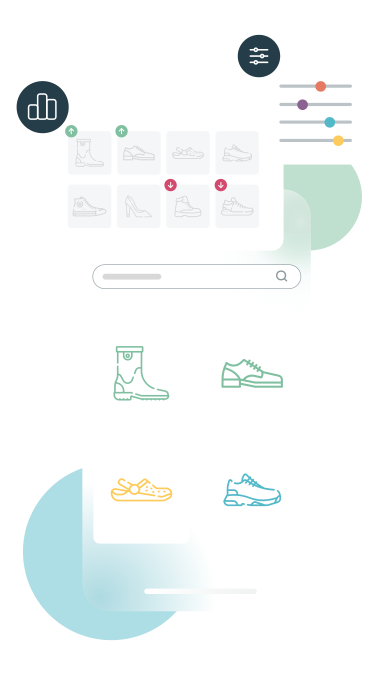
Every change made through these fine-tuning tools is tracked. Use the Playboard's Activity Stream tool to review, monitor, and revert configuration changes over time, so fine-tuning stays fully auditable.
Making search performance visible
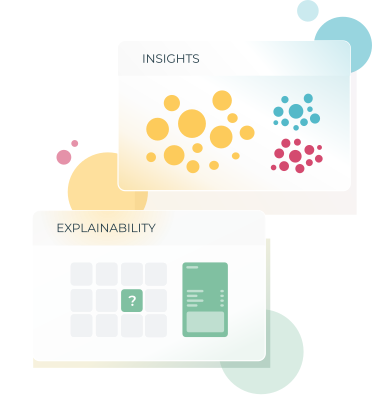
Because every keyword match resolves into a structured, traceable query, its performance is fully measurable rather than a guess. The Playboard's Analytics and Insights tools turn that into something merchandisers can act on: tracking how search is evolving overall, spotting which queries return nothing, seeing what's happening in real time, and surfacing the terms and categories shoppers actually engage with, so fine-tuning decisions are based on evidence rather than intuition.
Not every decision needs a trip to the Playboard. Empathy Platform Backroom surfaces real-time key metrics, like clicks and add-to-cart, directly in the store's search bar, so merchandisers can check performance and even boost or bury products on the spot, without logging into a separate tool. Use Backroom for quick, on-the-go checks, and the Playboard's Analytics and Insights for deeper analysis and strategy.
Staying explainable
Keyword search has a natural advantage over more interpretive search types: because a result comes from a direct term match plus a defined set of ranking criteria, its ranking is explainable by construction, not by exception. There's no black box to open: the same criteria a merchandiser configures are the ones that placed a product where it is.

Empathy Platform layers relevance signals like collective, privacy-preserving shopping patterns on top of that foundation without breaking the transparency, and provides merchandisers with the Explain tool. A way to inspect exactly how any product's score and position came to be, and to adjust the configuration behind it when something looks off.
Data privacy at the core of search design
At Empathy Platform, search is generally private by design. By definition, keyword search is the most privacy-simple search type: matching typed terms to catalog terms requires no personal data at all. Where it does draw on shopper behavior for organic search suggestions or contextualized relevance, keyword search works exclusively from anonymized, aggregated collective signals, never individual profiling. Empathy Platform's search data flow is private by design at every stage and fully compliant with all major privacy laws like General Data Protection Regulation (GDPR) and California Consumer Privacy Act (CCPA).
Learn more in Understand data privacy in Empathy Platform
Keywords as the structural search base
Keyword search is the foundation, not the ceiling. When exact-match relevance runs out for long-tail queries, misspellings, shoppers who don't know a catalog's exact terms, or intent that takes more than a few words to express, Empathy Platform layers Semantic Search, AI Search, and Conversational Search on top of it, each extending what a shopper can find without discarding the ranking rules and business logic keyword search already put in place.
Understanding keyword search is understanding the foundation the rest of Empathy Platform's search approaches are built on.
Explore the other Empathy Platform's search approaches